Bachelor of Science Degree in Mechanical Engineering
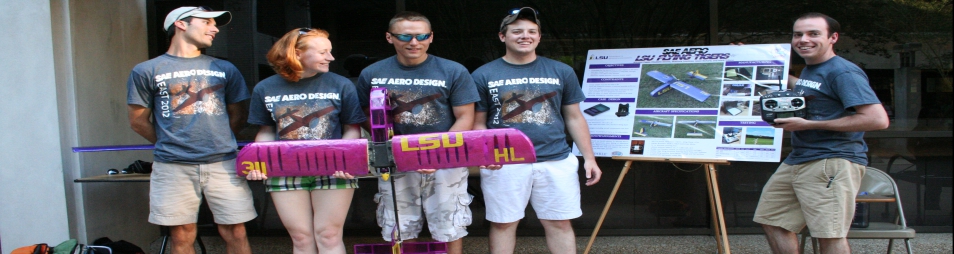
Summary: The undergraduate Bachelor of Science in Mechanical Engineering (BSME) curriculum consists of 127-128 credit hours of course work and is multifaceted, rigorous, communications intensive and hands-on. In addition, opportunities exist to establish an area of specialization through one of the Minors to the BSME (e.g. Aero Minor, Materials Minor, Nuclear Power Minor) and others offered through other programs.
Project Management: Their Mechanical Engineering education is the first challenging project aspiring engineering students face, and in true engineering fashion, it is best to plan and manage it in order to maximize the benefits while minimizing costs (monetary and otherwise).
Timing: The curriculum is designed for a four year program under the condition that the student approaches it as a full-time job. Students who need to work their way through college or have time commitments to other activities (e.g. LSU Band, Athletics, a double major, etc.) are advised to plan a longer stay, adding one or two years depending on external work-load. This is much preferable than risking a decrease in performance and Grade Point Average (GPA) because of overload, which may inhibit them from accessing employment opportunities.
Added Value - Practical Experience: The MIE Department faculty also strongly recommends the pursuit of industry internships and co-ops as a means of developing practical skills, exploring potential employers and earning money to defray cost of living and education expenses. Most engineering employers use their pool of interns as the primary source for filling full-time, entry-level engineering positions. All students are advised to pursue such opportunities through LSU Career Services.
Added Value - Minors: If their educational plan calls for a prolonged stay, students are also encouraged to pursue one or more areas of specialization through Minors to the BSME that are offered through the MIE Department or other programs. Currently Minors are offered through MIE in Aerospace, Materials, Nuclear Power and International Automotive areas. These typically require at least 6 credit hours in addition to the plain BSME credit hour count.
Summary of the Curriculum
The general breakdown of course work in terms of credit hours is as follows:
| Course | Hours |
|---|---|
| English | 6 hours minimum |
| Humanities and the Arts | 18 hours |
| Mathematics and Computing | 20 hours |
| Life Sciences | 3 hours |
| Physics and Chemistry | 13-14 hours |
| Basic Engineering | 21 hours |
| ME Thermal Science | 15 hours |
| ME Design | 19 hours |
| ME Materials | 6 hours |
| ME Electives | 6 hours |
This rigorous program culminates in the year-long Capstone "Senior" Design course sequence that requires student teams to conceive, design, manufacture and test an engineered system, piece of equipment or apparatus. Often these projects are sponsored by persons or organizations outside the University, and especially so by industry. Many of the projects are multi-disciplinary in nature and are undertaken by interdisciplinary teams. Some designs have resulted in the issue of patents to the students. This design experience brings together in a practical way all of the theoretical training that the students have received throughout the curriculum. It is a holistic experience because it hones other important attributes such as leadership, project management, teamwork, responsibility, accountability, oral and written communication skills, and in some cases entrepreneurship.
BSME Curriculum Core Courses and Suggested Schedule (Full Time)
The course rubrics appearing in bold italics are considered from experience as the most challenging in the ME curriculum and require a considerable time investment from the student.
| Freshman Year | Semester Hours |
|---|---|
| Chemistry 1201**, 1202**, 1212 | 6 - 8 |
| Construction Management 1020 | 2 |
| English 1001** | 3 |
| Mathematics 1550**, 1552** | 9 |
| Physics 2101, 2108 | 3-4 |
| General Education** | 3 |
| Life Sciences | 3 |
| Total | 30-31 |
| Sophomore Year | Semester Hours |
|---|---|
| Civil Engineering 2450, 3400 | 6 |
| ME 2543 | 3 |
| Electrical Engineering 2950 | 3 |
| English 2000** | 3 |
| Mathematics 2057, 2090 | 7 |
| ME 2212, 2334, 2723, 3133, 3701 | 13 |
| Physics 2102 | 3 |
| Total | 35 |
| Junior Year | Semester Hours |
|---|---|
| Economics 2030** | 3 |
| Electrical Engineering 3950 | 2 |
|
ME 3143, 3603, 3633, 3752, 3834, 4133, 4244, 4433, 4611 |
26 |
| General Education** | 3 |
| Total | 34 |
| Senior Year | Semester Hours |
|---|---|
| ME 4183, 4201, 4202, 4243, 4621 | 10 |
| General Education** | 12 |
| Approved Technical Electives | 6 |
| Total | 28 |
A grade of "C" or better is required in Chemistry 1202, Mathematics 1552, and Physics 2101 (or equivalent courses) before a student may enroll in Mechanical Engineering 2334. ROTC is optional.
**Arts/Humanities/Biological or Social Sciences Course.
Approved Technical Electives
Effective Spring 2016
Petitions to deviate from these requirements must be submitted through the me undergraduate coordinator for consideration by the ME Faculty.
TECH A (Minimum of 6 Credit Hours Required)
Thermal/Fluid Systems
ME 4443 - Combustion
ME 4633 - Internal Combustion Engines
- ME 4443 - Combustion
- ME 4633 - Internal Combustion Engines
- ME 4643 - Thermal Environmental Engr.
- ME 4663 - Renew. & Nuclear Pwr Plt Engr.
- ME 4813 - Interd. Fluids: Physical Concepts
- ME 4823 - Interd. Fluids: Comp. Methods
- ME 4843 - Gas Dynamics
- ME 4853 - Turbomachinery
- ME 4863 - Fluid Power Systems
- ME 4143 - Mechanical Vibrations ***
- ME 4193 - Vehicle Dynamics
- ME 4213 - Welding Engineering I
- ME 4223 - Welding Engineering II
- ME 4273 - Stress Analysis in ME
- ME 4293 - Microsys Fab & Design
- ME 4673 - Intro to Modern Control Theory
- ME 4683 - Sensors & Actuators
- ME 4723 - Advanced Materials Analysis
- ME 4733 - Deformation & Fracture
- ME 4743 - Kinetics in Materials Processes
- ME 4763 - Fundamentals of Corrosion
- ME 4783 - Composite Materials: Mfg, Prop & Design
- ME 4913 - Aerodynamics
- ME 4923 - Jet & Rocket Propulsion
- ME 4953 - Nuclear Reactor Engr. Design
- ME 4963 - Nuclear Reactor Systems Engr.
- ME 4973 - Space Systems
*To count towards Tech A, the following robotics engineering courses must be taught by an ME faculty member.
- ENGR 4100 - Industrial Robotics
- ENGR 4103 - Assistive Robotics
- ENGR 4200 - Autonomous Vehicles
- ME 4903 - Spec Proj for Undergraduates
- ME 4933 - Special Problems in Mech. Engr.
- ME 4943 - Special Problems in Aero. Engr.
*Semester may vary, depending on faculty availability and student demand.
*Students must have taken ME 3143 Sys Dynamics to use ME 4143 as Tech Elective.
ME CURRICULA PRIOR TO Academic Year 2012-2013 REQUIRE THREE (3) TECH ELECTIVES OF WHICH ONLY ONE (1) CAN BE A TECH B TAKEN FROM THE APPROVED LIST BELOW.
TECH B (Maximum of 3 Credit Hours)
- ME 3249/3250 • Engineering Practice
- Most 4000 level Math courses are also acceptable, including MATH 4031, 4032, 4036, 4055, 4056, 4060, 4065, 4066 or MATH 4038/ME 4563.
Biological Engineering
- BE 4342 - Sugar Process Engineering
- BE 4347 - Sugar Factory Design
Chemical Engineering
- CHE 4253 - Intro to Industrial Pollution Control
Chemistry
- CHEM 3491/3492 - Physical Chemistry
Civil Engineering
- CE 4440 - Advanced Mechanics of Materials
- CE 4450 - Finite Element Methods
Computer Science
- CSC 2252 - Assembly Language Prog.
- CSC 3102 - Adv. Data Struct & Algor. Anal.
- CSC 4362 - Advanced Numerical Methods
- CSC 4444 - Artificial Intell. & Pattern Recog
- CSC 4356 - Computer Graphics
- CSC 4357 - Applied Computer Graphics
Electrical Engineering
- EE 3232 - Solid State Devices I
- EE 4232 - Solid State Devices II
- EE 4730 - 3D Graphics & Geom. Modeling
- EE 4740 - Discrete Struct. for Comp. Engr.
- EE 4750 - Microprocessor Interfacing Tech
Environmental Engineering
- EVEG 3110 - Water and Wastewater Treatment
- EVEG 4120 - Design of Solid & Hazardous Waste Management Systems
- EVEG 4153 - Hazardous Waste Management
Industrial Engineering
- IE 3201 - Principles of Engineering Economy (or PETE 3025, not both)
- IE 3302 - Engineering Statistics
- IE 4453 - Industrial Quality Control
- IE 4461 - Human Factors Engineering
- IE 4462 - Safety Engineering
- IE 4785 - Extreme Environment and Habitat Design
Nuclear Science
- NS 3411 - Fund of Nuclear Radiation Science
- NS 4570 - Nuclear Facility Safety
Petroleum Engineering
- PETE 3025 - Econ Aspects of Petr Prod
- PETE 3036 - Well Logging
- PETE 4045 - Drilling Engineering
Physics
- PHYS 4125 - Thermo & Statistical Mech.
- PHYS 4261 - Intro to Solid-State Physics
Renewable Natural Resources
- RNR 4036 - Forest Management
- RNR 4038 - Forest Resource Economics